Implementing Idempotent HTTP APIs with the Idempotency-Key Header
Introduction
As systems grow larger, communication between different backend services becomes more frequent and more complex — and with more network calls comes a higher chance of network failures. These failures can stem from many causes: brief network blips, client-side connection timeouts, packet loss, and so on.
Digging into the root cause every single time is expensive, and even when you find it, preventing recurrence is hard — because in many cases the fix is simply retrying the request.
This is why designing idempotent HTTP APIs matters. Let’s dive in.
Terminology
Two concepts come up throughout this post:
- Idempotency: a property from math and computer science where applying an operation multiple times produces the same result as applying it once. f(f(x)) = f(x)
- Resilience: a system’s ability to keep functioning, or recover quickly, in the face of external shocks or failures.
Idempotency
With a non-idempotent HTTP API, a client that hits a timeout or an unstable connection is left in an uncertain state. Was the resource created? Was it updated? Did the server finish processing the request at all? Worse, the client can’t even tell whether it is safe to retry.
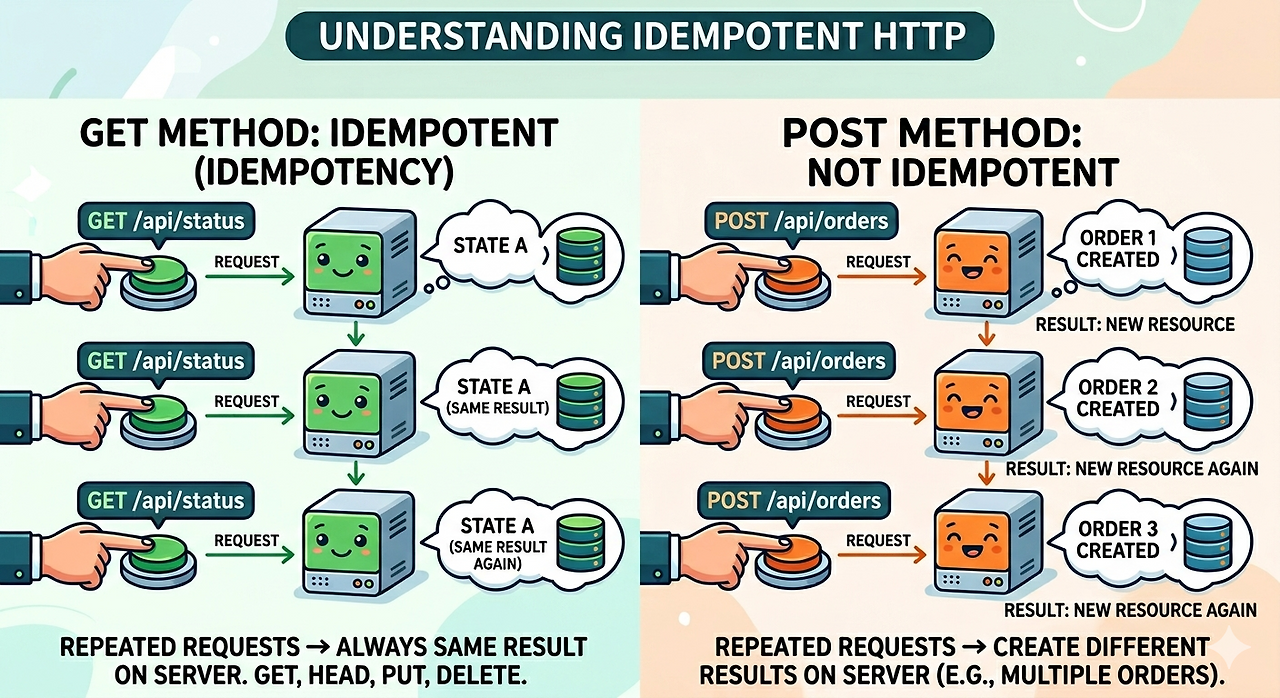
That’s why APIs that create, update, or delete resources should provide idempotency — it gives clients a safe foundation for retries and makes the whole system far more resilient.
So how do we design it?
Architecture
There are several approaches, but this design follows the IETF draft:
The Idempotency-Key HTTP Header Field
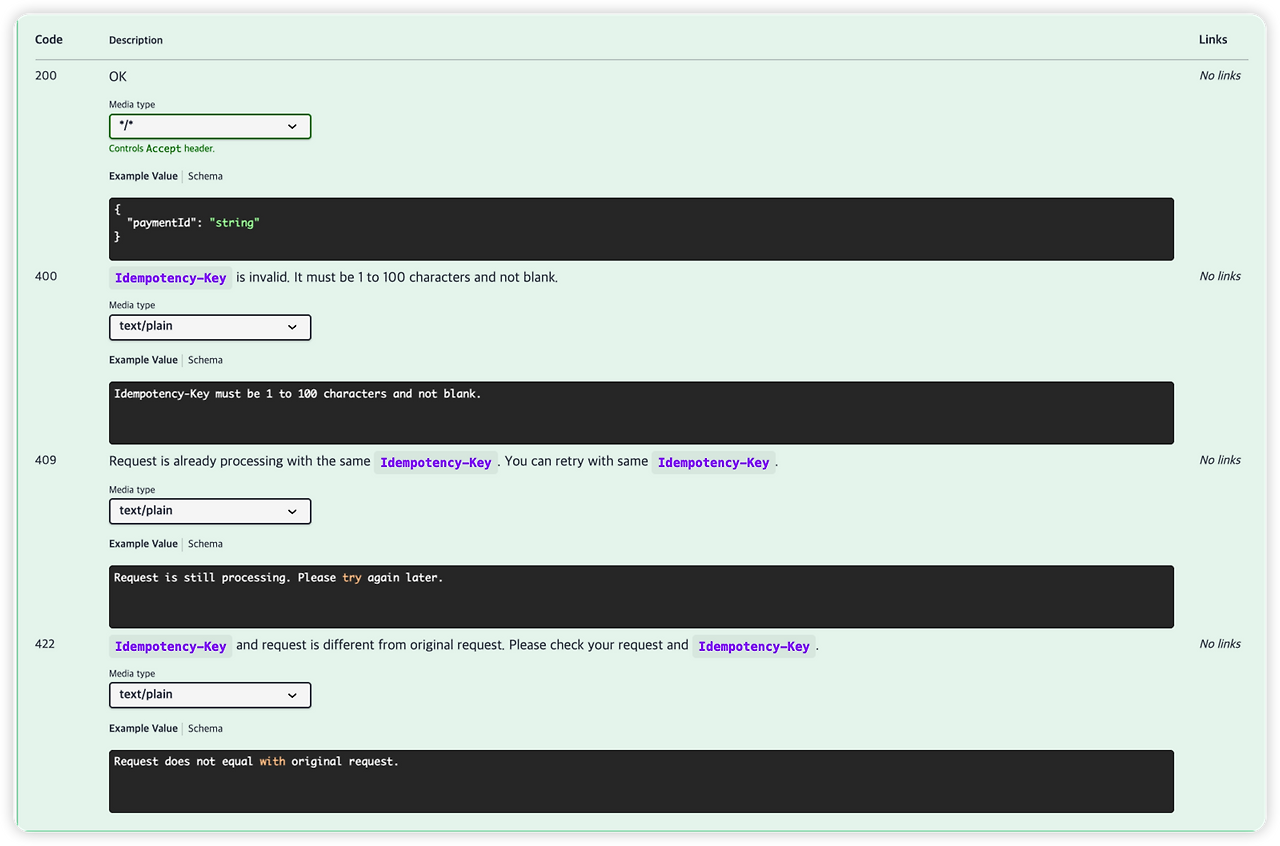
The draft defines an optional Idempotency-Key HTTP header. The core of the design is distinguishing the following cases:
- First request — process normally, return HTTP 200, and persist both the request and response in a repository (adding a TTL makes operations much easier).
- Second request — same
Idempotency-Keyand same request body, with a stored result on the server: return the stored response. - Duplicate request — same
Idempotency-Keyarrives again within a short window (i.e., the first one is still processing): return HTTP 409 to signal it’s already in progress. - Invalid request — same
Idempotency-Keybut a different request body: return HTTP 422 to signal the request can’t be processed. - Invalid request — the header violates length constraints: return HTTP 400.
Case 2 is the important one — it’s what lets clients retry easily. Case 3 tells the client to back off a bit longer before retrying. Case 4 guards against client implementation mistakes and tampering.
In Spring, this can be implemented as a servlet filter. The core flow looks like this (abridged — full source linked below):
1
2
3
4
5
6
7
8
9
10
11
12
13
14
15
16
17
18
19
20
21
22
23
24
25
26
27
28
29
30
31
32
33
34
35
36
@Component
class IdempotentHttpWebMvcFilter(
    private val registry: IdempotentHttpWebMvcRegistry,
    private val repository: IdempotentHttpRepository,
) : OncePerRequestFilter(), OrderedFilter {

    override fun doFilterInternal(
        request: HttpServletRequest,
        response: HttpServletResponse,
        filterChain: FilterChain
    ) {
        val key = request.getHeader(IdempotencyHeader.IDEMPOTENCY_KEY)
        when {
            key == null -> filterChain.doFilter(request, response)
            key.isBlank() || key.length > 100 ->
                response.reject(HttpStatus.BAD_REQUEST)          // case 5
            registry.notRegistered(request.method, request.requestURI) ->
                response.reject(HttpStatus.BAD_REQUEST)
            else -> processIdempotentHttp(/* ... */)
        }
    }

    private fun processIdempotentHttp(/* ... */) {
        val existing = repository.findByIdOrNull(idempotentHttpId)
        when {
            existing == null ->
                doFilterAndRecord(/* ... */)                     // case 1
            existing.isDifferentRequest(currentRequest) ->
                response.reject(HttpStatus.UNPROCESSABLE_ENTITY) // case 4
            existing.response == null ->
                response.reject(HttpStatus.CONFLICT)             // case 3
            else ->
                response.replay(existing.response)               // case 2
        }
    }
}
One implementation detail worth noting: if saving the response fails after the request was processed, reliable idempotency can no longer be guaranteed — so the record itself should be deleted to avoid incorrectly returning 409 on the next retry.
For the repository, pick a store that supports TTL. Redis is my recommendation: key-value commands make concurrency control simple, and it’s fast to implement.
Full source code is available here:
GitHub - huisam/spring-idempotency
Client configuration
How should clients configure the Idempotency-Key header and their retry strategy?
For the header:
- Use a unique key per API request — UUID v4 is strongly recommended.
- On HTTP 409, the server is still processing; retry later with the same
Idempotency-Key. - The server records every outcome, success or failure. The goal is to remove uncertainty about “what did the client attempt, and what was the result?” To make a genuinely new attempt, use a new
Idempotency-Key.
Recording failures includes business failures. For example, if a payment API call fails because the card is expired, that failure response is recorded too. The point of the Idempotency-Key is not to guarantee a single success — it’s to record the outcome of the operation, whatever it was.
For retries:
- Too many retries, or retries at too short an interval, only make things worse for the server. Cap the retry count and use exponential backoff.
- Recommended defaults:
- maxAttempts: 3
- exponential backoff — initial delay: 2s, multiplier: 2
Exponential backoff reduces server load and avoids repeatedly hitting the “still processing” response. Since processing time varies per API, publish recommended values per API; for high-latency endpoints, just bump the initial delay.
Closing
Today we looked at idempotency and how to build idempotent APIs with the Idempotency-Key HTTP header. It’s an essential ingredient for running a resilient system in an MSA environment — give it a try in your own services.