[Kotlin] Coroutine - 2. Digging into CoroutineScope, Context & Dispatcher
In Coming
The way a coroutine actually behaves still does not quite click, does it?
How on earth does it only look like things run at the same time?
How does a coroutine hop back and forth between threads while it gets work done?
How does a coroutine pull off this magic-looking concurrent processing?
To build that understanding we are going to walk through the code piece by piece. Before we do, let’s go over the elements a coroutine needs in order to run.
The Building Blocks of a Coroutine
To see how those blocks fit together, let’s create one simple coroutine.
1
2
3
4
5
6
7
CoroutineScope(Dispatchers.Default).launch {
    println("Starting in ${Thread.currentThread().name}")
    delay(500)
}.join()

public fun CoroutineScope(context: CoroutineContext): CoroutineScope =
    ContextScope(if (context[Job] != null) context else context + Job())
When we create a coroutine, we can see that we use a CoroutineScope and a Dispatcher to specify a CoroutineContext.
Let’s look at what each of these terms means and what their interfaces look like.
CoroutineScope
CoroutineScope means the scope of a coroutine. Think of it as the overall scope that shares the coroutine’s lifecycle.
1
2
3
4
5
6
7
8
9
10
public interface CoroutineScope {
    /**
     * The context of this scope.
     * Context is encapsulated by the scope and used for implementation of coroutine builders that are extensions on the scope.
     * Accessing this property in general code is not recommended for any purposes except accessing the [Job] instance for advanced usages.
     *
     * By convention, should contain an instance of a [job][Job] to enforce structured concurrency.
     */
    public val coroutineContext: CoroutineContext
}
Because of that, the only property on the interface is a single CoroutineContext field.
In other words, among the elements that manage a coroutine, this is the interface with the widest scope.
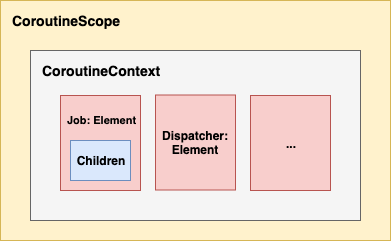 CoroutineScope is the interface with the widest scope
CoroutineContext
To put it simply, a CoroutineContext is the set of things that make up a coroutine.
1
2
3
4
5
6
7
8
9
10
11
12
13
14
15
16
17
18
19
20
21
22
23
24
25
public interface CoroutineContext {

    public operator fun <E : Element> get(key: Key<E>): E?

    public fun <R> fold(initial: R, operation: (R, Element) -> R): R

    public operator fun plus(context: CoroutineContext): CoroutineContext =
        if (context === EmptyCoroutineContext) this else // fast path -- avoid lambda creation
            context.fold(this) { acc, element ->
                val removed = acc.minusKey(element.key)
                if (removed === EmptyCoroutineContext) element else {
                    // make sure interceptor is always last in the context (and thus is fast to get when present)
                    val interceptor = removed[ContinuationInterceptor]
                    if (interceptor == null) CombinedContext(removed, element) else {
                        val left = removed.minusKey(ContinuationInterceptor)
                        if (left === EmptyCoroutineContext) CombinedContext(element, interceptor) else
                            CombinedContext(CombinedContext(left, element), interceptor)
                    }
                }
            }

    public fun minusKey(key: Key<*>): CoroutineContext

    public interface Key<E : Element>
}
Looking at the functions the interface provides, a CoroutineContext is composed of Elements, and each Element can be added or pulled back out through get or fold.
On top of that, by plus-ing or minus-ing another CoroutineContext you can merge or remove a specific Element.
So you can understand a CoroutineContext as the persistent context of a coroutine.
Among the elements that make up such a context, there is an implementation called the Dispatcher.
Dispatcher
The Dispatcher is responsible for deciding how the coroutine’s tasks get distributed for execution.
To be precise, it is the Interceptor that makes a coroutine suspend or resume its work — but that part comes later.
1
2
3
4
5
6
7
8
9
10
11
12
13
14
15
16
17
18
19
20
21
22
23
24
public abstract class CoroutineDispatcher :
    AbstractCoroutineContextElement(ContinuationInterceptor), ContinuationInterceptor {

    /** @suppress */
    @ExperimentalStdlibApi
    public companion object Key : AbstractCoroutineContextKey<ContinuationInterceptor, CoroutineDispatcher>(
        ContinuationInterceptor,
        { it as? CoroutineDispatcher })

    public open fun isDispatchNeeded(context: CoroutineContext): Boolean = true

    public abstract fun dispatch(context: CoroutineContext, block: Runnable)

    @InternalCoroutinesApi
    public open fun dispatchYield(context: CoroutineContext, block: Runnable): Unit = dispatch(context, block)

    public final override fun <T> interceptContinuation(continuation: Continuation<T>): Continuation<T> =
        DispatchedContinuation(this, continuation)

    public final override fun releaseInterceptedContinuation(continuation: Continuation<*>) {
        val dispatched = continuation as DispatchedContinuation<*>
        dispatched.release()
    }
}
Through the dispatch method it throws a Runnable task around in whatever way the concrete implementation defines, and that is how the coroutine’s work gets executed.
If you look at the code of the Event Loop, one of the implementations that manage tasks:
1
2
3
4
5
6
7
8
9
10
public final override fun dispatch(context: CoroutineContext, block: Runnable) = enqueue(block)

public fun enqueue(task: Runnable) {
    if (enqueueImpl(task)) {
        // todo: we should unpark only when this delayed task became first in the queue
        unpark()
    } else {
        DefaultExecutor.enqueue(task)
    }
}
The Dispatcher really does nothing more than put the task into the Event Loop queue and call it a day.
There is nothing else going on.
1
2
3
4
5
6
7
8
9
10
11
12
13
14
15
16
17
18
19
20
21
22
23
24
25
26
27
override fun processNextEvent(): Long {
    // unconfined events take priority
    if (processUnconfinedEvent()) return 0
    // queue all delayed tasks that are due to be executed
    val delayed = _delayed.value
    if (delayed != null && !delayed.isEmpty) {
        val now = nanoTime()
        while (true) {
            // make sure that moving from delayed to queue removes from delayed only after it is added to queue
            // to make sure that 'isEmpty' and `nextTime` that check both of them
            // do not transiently report that both delayed and queue are empty during move
            delayed.removeFirstIf {
                if (it.timeToExecute(now)) {
                    enqueueImpl(it)
                } else
                    false
            } ?: break // quit loop when nothing more to remove or enqueueImpl returns false on "isComplete"
        }
    }
    // then process one event from queue
    val task = dequeue()
    if (task != null) {
        task.run()
        return 0
    }
    return nextTime
}
Then the thread that manages the Event Loop dequeues the tasks one by one, pulls each one out and runs it.
In other words, the Dispatcher has nothing to do with how a coroutine works — its only responsibility is the distribution of tasks.
So How Does a Coroutine Flow?
Pretty tough going, right?
Based on what we have learned so far, let’s tidy this up one more time.
To make it easier to follow, let’s keep going with a sample piece of code.
1
2
3
4
5
6
7
8
9
10
11
12
13
14
15
16
17
18
fun main() {
    println("Starting a coroutine block...")
    runBlocking {
        println(" Coroutine block started")
        launch {
            println("  1/ First coroutine start")
            delay(100)
            println("  1/ First coroutine end")
        }
        launch {
            println("  2/ Second coroutine start")
            delay(50)
            println("  2/ Second coroutine end")
        }
        println(" Two coroutines have been launched")
    }
    println("Back from the coroutine block")
}
This code creates an EmptyCoroutineContext via runBlocking, then creates and runs several coroutines inside that scope.
As I mentioned last time, coroutines only look like they run at the same time. So what does the output look like?
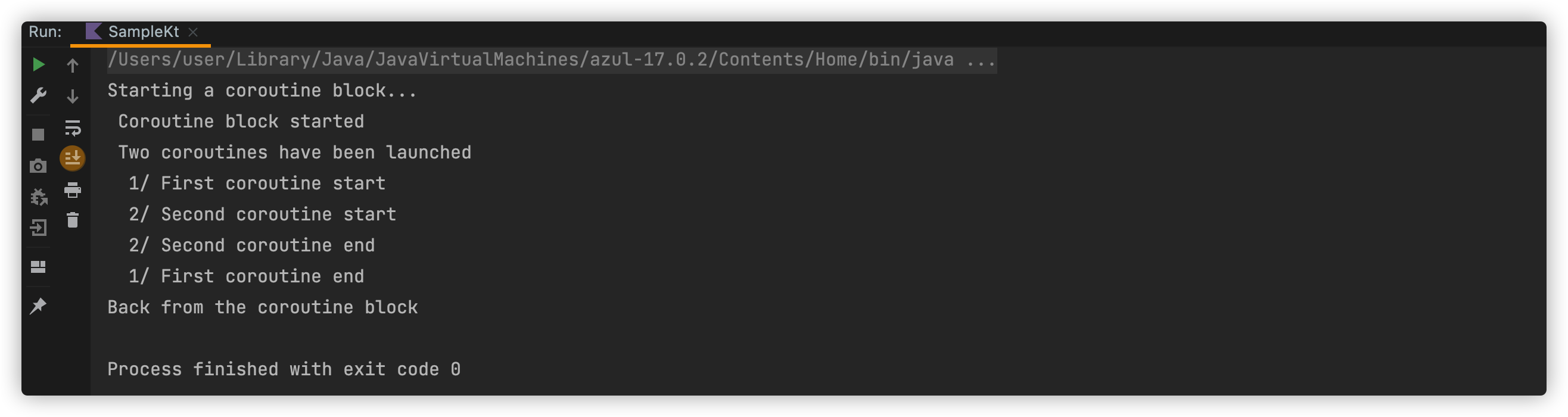 Execution result
Just as expected, we can see coroutine 1 and coroutine 2 starting at the same time.
What does that look like internally?
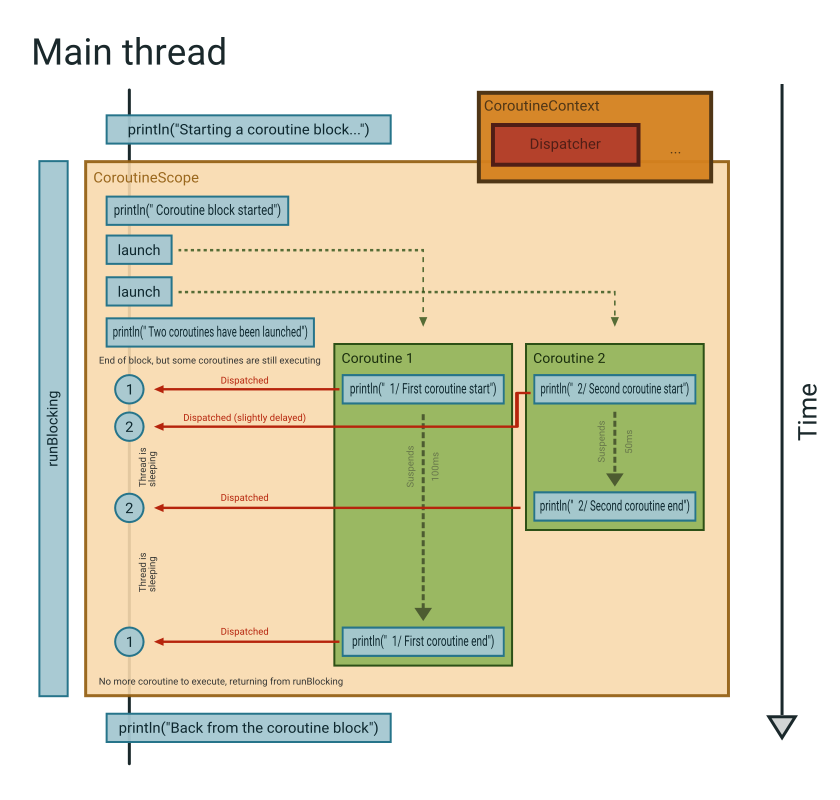 The flow of execution
Coroutine 1 is created, the default Dispatcher throws the task, and it is executed immediately.
The same goes for coroutine 2: it is created, the default Dispatcher throws the task, and it runs immediately.
So the total elapsed time came out close to 100ms — the longest of the two delays!
But here a question comes up.
Coroutine 1 called delay, so how is coroutine 2 able to run right away?
The Dispatcher only threw the task somewhere — so how did it manage to work around the blocking section?
I’ll go deeper into how a coroutine really finds a suspension point, how it marks that point, and how it knows to resume from there.
For that part, take a look at the post below 😄
[Kotlin] Coroutine - 6. Let’s deep dive into suspend functions
Wrapping Up
CoroutineScopemeans the scope of a coroutine — the overall scope that shares the coroutine’s lifecycle.CoroutineContextis the set of things that make up a coroutine.Dispatcherdecides how the coroutine’s tasks get distributed for execution.